Two Products, Two Different Jobs
Spray foam and fiberglass both insulate, but they don't perform the same. Here's an honest side-by-side covering R-value, air sealing, moisture, longevity, cost, and where each one makes sense on a real building.
The Core Difference
The simplest way to put it: fiberglass insulates, while spray foam insulates and air-seals. That distinction drives almost every other comparison.
Fiberglass slows heat transfer by trapping air between glass fibers. The fibers themselves resist heat, and the air pockets do the heavy lifting. But fiberglass has to be installed perfectly to work — every gap, every void, every compressed batt is a place where air and heat move freely.
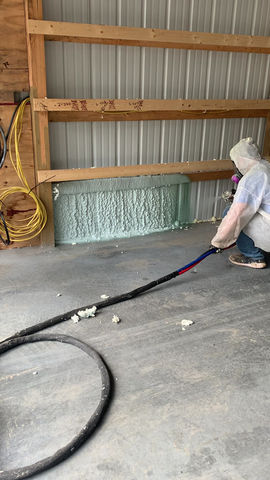
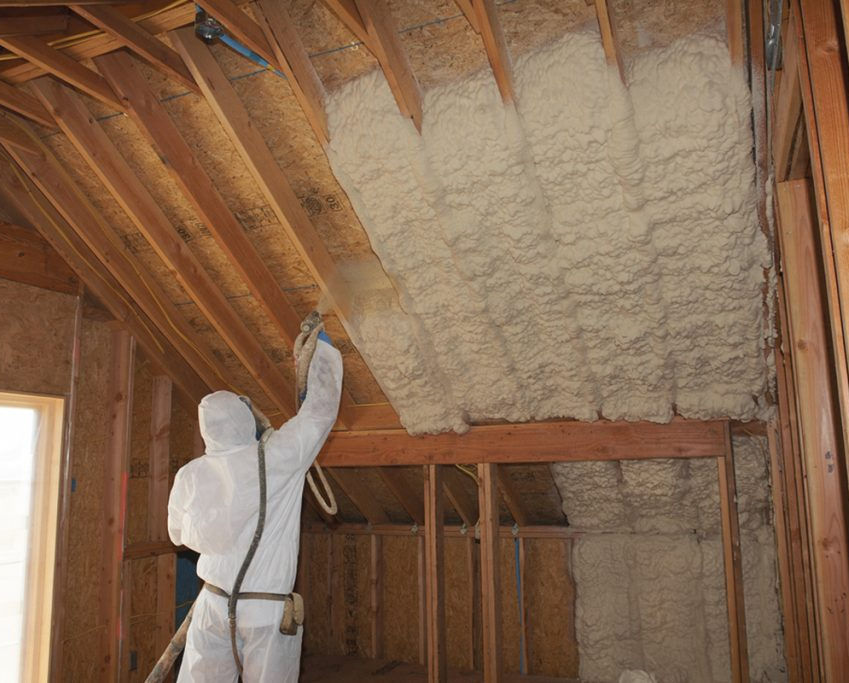
Spray foam is a two-part liquid that expands on contact. It fills the cavity, hardens in seconds, and becomes both the insulation and the air barrier in one step. The same job that takes three trades with fiberglass — framing, insulating, and air sealing — takes one trade with spray foam.
R-Value Comparison
R-value measures resistance to heat flow. On paper, the two products look closer than they actually perform.
Open-cell spray foam is rated at roughly R-3.5 to R-3.7 per inch. Closed-cell spray foam runs about R-6 to R-7 per inch. Fiberglass batt insulation is rated around R-3.1 to R-4.3 per inch depending on density.
Those lab numbers don't tell the whole story. Fiberglass loses effective R-value in real buildings because of compression around wiring, gaps at the edges of batts, and air movement through the cavity. Spray foam doesn't have that problem because the foam fills the entire cavity with no gaps to leak through.
Key point: The R-value printed on the bag is a best-case number. The R-value you actually get in the wall depends entirely on how well air leakage is controlled — and that is where spray foam pulls ahead.
Air Sealing
This is the single biggest performance difference between the two products. According to the U.S. Department of Energy, sealing air leaks and adding insulation can save homeowners up to 10 percent on annual energy bills, and the air-sealing portion is most of the gain.
Fiberglass by itself does almost nothing to stop air movement. You can see the drafts around electrical boxes, plumbing penetrations, and attic hatches in any un-air-sealed home. Adding a separate air barrier — like taped sheathing or a vapor barrier — is what closes those gaps. The insulation alone won't do it.
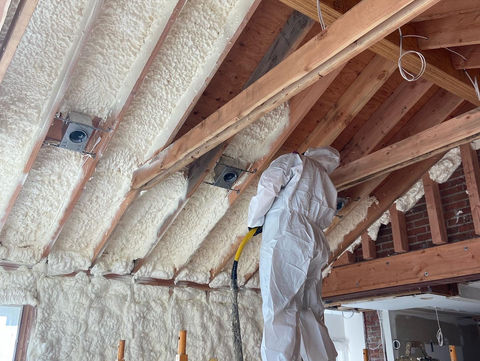
Spray foam expands into every gap and penetration, then cures into a continuous air barrier. There is no separate sealing step and no air-permeable joints to worry about. In a tight building envelope, that air sealing is what delivers the comfort and energy performance.
Moisture and Mold
Fiberglass is an air-permeable material. When warm, moist indoor air reaches a cold fiberglass surface — like the inside of an exterior wall in winter — it condenses. Over time that moisture leads to mold, mildew, and lost R-value. Fiberglass that has gotten wet may also compress and slump, leaving uninsulated voids in the cavity.
Closed-cell spray foam is a Class II vapor retarder at typical installed thicknesses and acts as its own moisture barrier. It does not absorb water, does not provide a food source for mold, and holds its R-value in humid conditions. Open-cell spray foam is vapor-permeable but still resists moisture absorption and dries quickly if it ever does get wet.
Longevity
Spray foam is permanent. The cells do not settle, sag, or compress under normal conditions, and the R-value does not degrade over time. A properly installed foam job performs the same in year twenty as it did in year one.
Fiberglass settles. Industry sources commonly cite a 15 to 20 year service life for fiberglass insulation, after which sagging, compression, and gaps become visible in attics and walls. In wet or pest-prone environments the lifespan is shorter.
Installation
Fiberglass is the classic DIY product. A homeowner with a utility knife, a stapler, and a dust mask can install batts in a few hours. It is forgiving, widely available at any home center, and the materials are inexpensive.
Spray foam requires professional equipment, trained installers, and personal protective equipment. The two chemicals have to be mixed at the right ratio, at the right temperature, at the right pressure. Done wrong, the foam either doesn't cure or doesn't perform. Done right, it is the most reliable insulation in the building.
Cost
Fiberglass is cheaper upfront. A standard batt runs roughly $0.50 to $1.50 per square foot for materials. Installed costs for a professional fiberglass job in an open attic typically run $1 to $2 per square foot, depending on the region.
Spray foam costs more. Open-cell runs roughly $1 to $3 per square foot installed, and closed-cell runs $2 to $5 or more per square foot, depending on thickness, access, and the market. Those numbers come from industry cost guides and vary by region — treat them as a benchmark, not a quote.
The math changes once you factor in air sealing, longevity, and energy performance. A spray foam job that costs twice as much upfront but delivers 30 percent lower energy bills pays for itself in a few years in most climates, and then keeps performing for the life of the building.
Where Fiberglass Still Makes Sense
Fiberglass is not the wrong answer everywhere. It works fine when:
- Budget is the top priority and a separate air barrier is already in place.
- The cavity is interior — like a basement partition wall in conditioned space — and air sealing doesn't matter.
- The owner is doing the work and a small gap in performance is acceptable in exchange for low cost.
- The application is temporary — a shed, a workshop, or a space being built out incrementally.
For deeper context on where spray foam fits into the same projects, see our Why Liquid Green overview and the products page.
Where Spray Foam Wins
Spray foam is the right answer for the parts of the building where air sealing matters as much as R-value.
- Attics and rooflines — the largest source of air leakage in most homes, and where closed-cell or open-cell foam dramatically changes comfort.
- Rim joists — the band of framing between the foundation and the first floor, notorious for air and moisture intrusion.
- Basements and crawl spaces — moisture-sensitive spaces where closed-cell foam doubles as a vapor barrier.
- Cathedral ceilings — where you need high R-value in a thin profile without losing headroom to extra framing depth.
- Around penetrations — wiring, plumbing, and duct chases that fiberglass can never fully seal.
An Honest Verdict
It is not always one or the other. Many well-built homes use spray foam on the roofline and rim joists, where air sealing is critical, and fiberglass in the interior walls, where it isn't. That combination is often the most cost-effective way to hit both performance and budget.
The wrong move is treating them as interchangeable. They aren't. Picking the right product for the right assembly is what separates a drafty, expensive-to-heat house from a comfortable, efficient one.