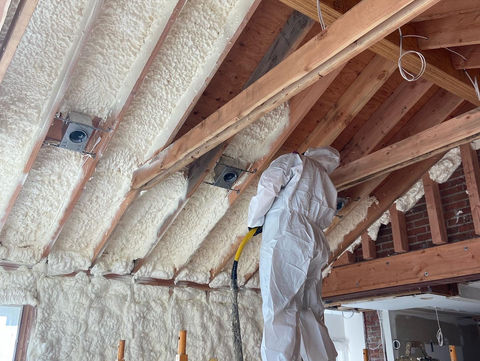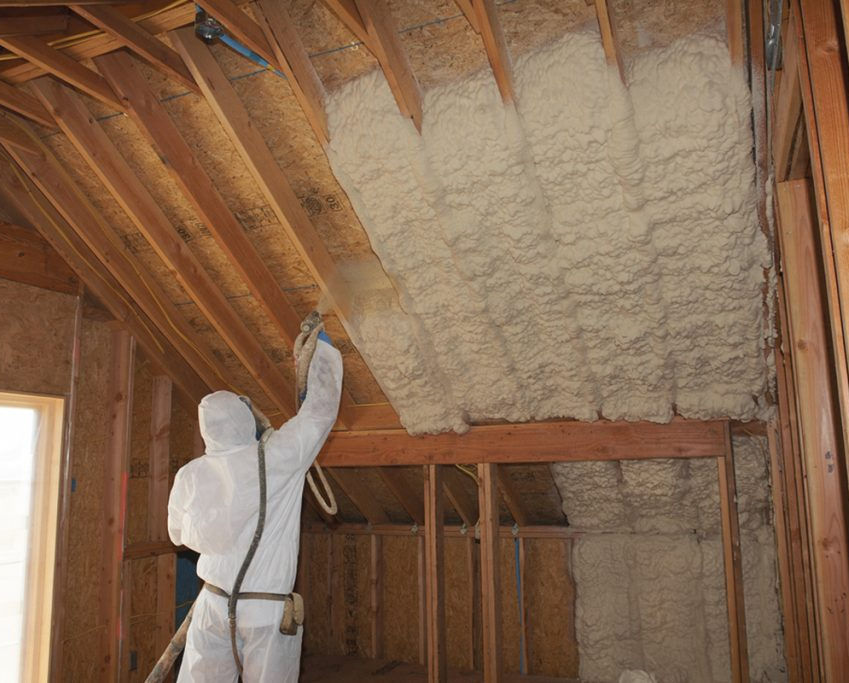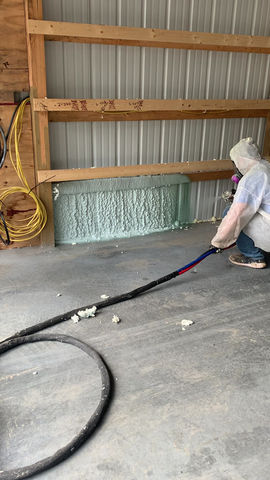
R-value is the most quoted number in insulation — and the most misunderstood. Here's what it actually means for spray foam, and where the headline number can fool you.
What R-Value Is
R-value is a measure of resistance to heat flow. The higher the R-value, the more the insulation resists heat moving through it. The unit is square foot · degree Fahrenheit · hour per BTU, but most people just remember "higher is better." The catch is that R-value is measured in a lab under steady-state conditions, which is a controlled environment that doesn't fully represent how insulation performs once it is inside a wall, attic, or rim joist. Still, the lab number is the most common comparison point across products, and the place every conversation starts.
R-Value Per Inch
Per inch, spray foam rates among the highest of any common insulation. The two products land in different ranges, and that difference drives most product decisions.
- Open cell spray foam: about R-3.5 to R-3.7 per inch.
- Closed cell spray foam: about R-6 to R-7 per inch.
- Fiberglass batt (typical): about R-3.1 to R-4.0 per inch.
- Blown cellulose: about R-3.2 to R-3.8 per inch.
- Mineral wool: about R-3.0 to R-3.3 per inch.
Per inch, closed cell is the clear leader and open cell is competitive with other common insulations. The per-inch number also tells you how thick an assembly needs to be to hit a code target, which matters in tight cavities.
Whole-Assembly R-Value Matters More
Code doesn't care about R-value per inch. Code requires an assembly R-value — the total R-value of the wall, roof, or floor as built, including studs, sheathing, drywall, and any continuous insulation layer. The whole-assembly number is what the inspector verifies.
This is where spray foam's air-sealing advantage starts to matter. A traditional insulated wall with batts can hit the same nominal R-value as a spray foam wall, but the spray foam wall does not have the air leakage paths that batt insulation allows. The spray foam assembly usually performs closer to its rated value, while the batt assembly can lose a meaningful share of its rated value to air movement through the cavity.
Effective R-Value vs. Rated R-Value
The rated R-value is the lab number on the data sheet. The effective R-value is what the insulation actually delivers in a real building. The two are not the same, and the gap between them is one of the most important things to understand about insulation.
Industry studies have measured that air leakage can reduce the effective R-value of fiberglass and cellulose assemblies by up to 50% in poorly sealed installations. Spray foam does not have that penalty because the foam itself is the air barrier. A spray foam wall rated at R-21 will often deliver closer to R-21 in the field, while a fiberglass wall rated at R-21 may deliver closer to R-10 to R-15 once air leakage is accounted for.
Climate Zones and Code
The International Energy Conservation Code (IECC) divides the country into eight climate zones, and the R-value requirements scale with how cold the winters get. Colder zones demand higher R-values; warmer zones can get by with less.
The tri-state area — New York, New Jersey, and Connecticut — sits primarily in IECC zones 4, 5, and 6, with colder upstate counties in zone 6 and the NYC metro in zone 4. Common assembly targets in these zones include R-20 to R-30 in walls, R-38 to R-60 in attics, and R-13 to R-30 in floors over unconditioned space. Local jurisdictions may also layer additional requirements on top of the IECC baseline, so the code target is always the one to verify before bidding.
Key point: The "right" R-value is the one your local code requires for that specific assembly. Buying more than code requires rarely pays back, while buying less can fail inspection or underperform in cold weather.
Open Cell vs. Closed Cell R-Value
The two foams get to the same code target in different ways. Here is the practical math, using R-40 in a roof as the example.
- Open cell at R-3.7 per inch: roughly 11 inches of foam to hit R-40.
- Closed cell at R-6.5 per inch: roughly 6 inches of foam to hit R-40.
Closed cell gets there in a thinner assembly, which is why it is the right call for cavity depths that are physically constrained — like a 2x4 wall, a vaulted ceiling, or a rim joist. Open cell needs more depth, but it costs less per board foot, so it can be the more economical pick in assemblies with room to grow, like a 2x10 floor joist or an open attic floor.
What the Numbers Don't Tell You
R-value is the most quoted number in insulation, but it is not the only thing that determines how the building performs. Three other factors matter as much, and sometimes more.
- Air sealing. Spray foam is an air barrier as well as an insulator. Batt and loose-fill insulations are not, and the air leakage that results can dwarf the rated R-value difference between products.
- Moisture control. Closed cell is a class II vapor retarder at typical installed thicknesses. Open cell is vapor-permeable. The right pick depends on the assembly and the climate zone, not on the R-value.
- Structural benefit. Closed cell adds meaningful racking strength to wall assemblies. Open cell does not.
How to Compare Insulation Honestly
If you are trying to compare two insulation bids, the right framing is not "which R-value is higher." It is "which assembly will perform closest to its rated R-value once it is installed." A spray foam wall with a lower nominal R-value often outperforms a batt wall with a higher nominal R-value once air leakage is accounted for.
Common Misconceptions
Two myths come up in almost every insulation conversation, and both are worth clearing up.
- "More R-value is always better." It is not. Insulation shows diminishing returns past the code-required level, so paying for significantly more than code requires rarely pays back. Air sealing and equipment efficiency usually deliver more for the next dollar.
- "R-value is the only thing that matters." It is not. Two walls with the same R-value can perform very differently because of air leakage, moisture control, and installation quality.
Conclusion: R-Value Is the Start, Not the Answer
R-value is the most useful single number in insulation, but it is the start of the conversation, not the end. Per inch, closed cell leads and open cell is competitive. In a real assembly, spray foam's air-sealing advantage often makes the rated R-value deliver closer to its true potential than other insulation types. The right pick is the one that matches the assembly, the climate zone, and the local code, not the one with the highest headline number.
For a homeowner comparing bids or a contractor choosing what to put on the truck, the framing is the same: ask what the assembly needs, what the code requires, and what the effective R-value will be in the wall — and let those answers drive the decision.