Everything You Want to Know About the Franchise Process
A practical, plain-English guide to the spray foam insulation franchise model — how the industry works, what training looks like, what the investment covers, how territories are defined, and what the path from inquiry to grand opening actually looks like.
Spray Foam Insulation — The Basics
Before talking franchise, it helps to understand what spray foam is, why it's different from other insulation, and why demand has been growing.
What is spray foam insulation and how does it work?
Spray polyurethane foam (SPF) is a two-part chemical mixture that is sprayed onto surfaces where it expands 30 to 60 times its liquid volume in seconds, filling cavities and forming a continuous, seamless insulation layer that hardens within minutes.
There are two main types:
Open-cell foam — softer, less dense, excellent sound dampening; typically used in interior walls, attics, and between floors.
Closed-cell foam — denser and rigid, adds structural strength, acts as a vapor barrier, and offers a higher R-value per inch; typically used in exterior walls, basements, rim joists, and roofs.
Both types achieve in a single application what traditional insulation (fiberglass batts, blown cellulose) cannot: complete air sealing plus thermal insulation in one step.
How does spray foam compare to fiberglass or cellulose?
Spray foam outperforms traditional insulation on every important measure:
Air sealing. Fiberglass and cellulose insulate but don't seal air leaks. Spray foam does both in one application.
R-value per inch. Closed-cell foam delivers roughly R-6 to R-7 per inch, open-cell roughly R-3.5 to R-3.7 — well above fiberglass (R-3.1 to R-4.0) and cellulose (R-3.2 to R-3.8).
Moisture resistance. Closed-cell foam is a Class II vapor retarder at 1.5" thickness and a Class I vapor barrier at 2"+ — fiberglass and cellulose absorb moisture and lose R-value when wet.
Air infiltration. Fiberglass loses up to 50% of its R-value from air movement through the material. Closed-cell spray foam stops air movement entirely.
Longevity. Spray foam doesn't settle, sag, or compact over time. Fiberglass and cellulose both lose effectiveness as they age.
Pest resistance. Spray foam has zero food value for rodents and insects; fiberglass and cellulose are nesting material.
The trade-off is upfront cost: spray foam is more expensive per board foot than fiberglass, but the long-term energy savings, air-sealing performance, and durability typically justify the premium for most whole-building applications.
What is R-value and why does it matter?
R-value measures a material's resistance to heat flow — the higher the R-value, the better the insulation. U.S. building codes set minimum R-values by climate zone (IECC climate zones 1-8) and by assembly (wall, ceiling, floor).
What matters most for homeowners is total assembly R-value — not just the insulation's per-inch rating, but how the whole wall, attic, or basement performs once installed. Spray foam's advantage is that it provides both insulation and air sealing in a single application, so the "effective" R-value in a real building is typically higher than the rated R-value of the material alone (because it eliminates the air-leak penalty that degrades the performance of fiberglass and cellulose).
Is spray foam insulation safe for homes?
Yes. Once cured (which takes 24 to 48 hours), modern spray polyurethane foam is inert and does not off-gas. The two key things to know:
Fire rating. Liquid Green uses Class 1 fire-rated foam, which is the highest classification for building insulation per ASTM E84. The foam self-extinguishes when the flame source is removed.
Indoor air quality during install. Installers and occupants should stay out of the building during the spray and for the full 24-hour cure period. Professional installers use proper respirators and ventilation during application. After cure, the foam is chemically stable.
All reputable spray foam products sold in the U.S. today are formulated to meet or exceed modern building code and indoor air quality standards.
How long does spray foam insulation last?
Spray foam is a permanent installation. Properly applied closed-cell and open-cell spray foam will perform for the life of the building — 50+ years — without settling, sagging, or losing R-value.
This is one of the material's biggest selling points for homeowners and builders. Fiberglass batts can settle and compact over 15 to 20 years; cellulose can lose up to 20% of its R-value over the same period. Spray foam's cellular structure is dimensionally stable indefinitely.
Is the spray foam insulation market growing?
Yes — three structural forces are driving demand:
Rising energy costs. Homeowners and commercial building owners are looking for the highest-R-value insulation available to control heating and cooling costs.
Stricter efficiency standards. State and local building codes (based on the International Energy Conservation Code) are tightening insulation and air-sealing requirements in most U.S. jurisdictions.
Strong residential and commercial demand. Spray foam is used in new construction and in retrofit/insulation upgrade projects, giving installers two distinct revenue streams per market.
As an emerging franchise category, spray foam is still a ground-floor opportunity compared to more saturated franchise industries.
How Spray Foam Franchising Works
A franchise lets you operate under an established brand and proven system. Here's how that applies specifically to a spray foam insulation business.
What does a spray foam franchise actually do?
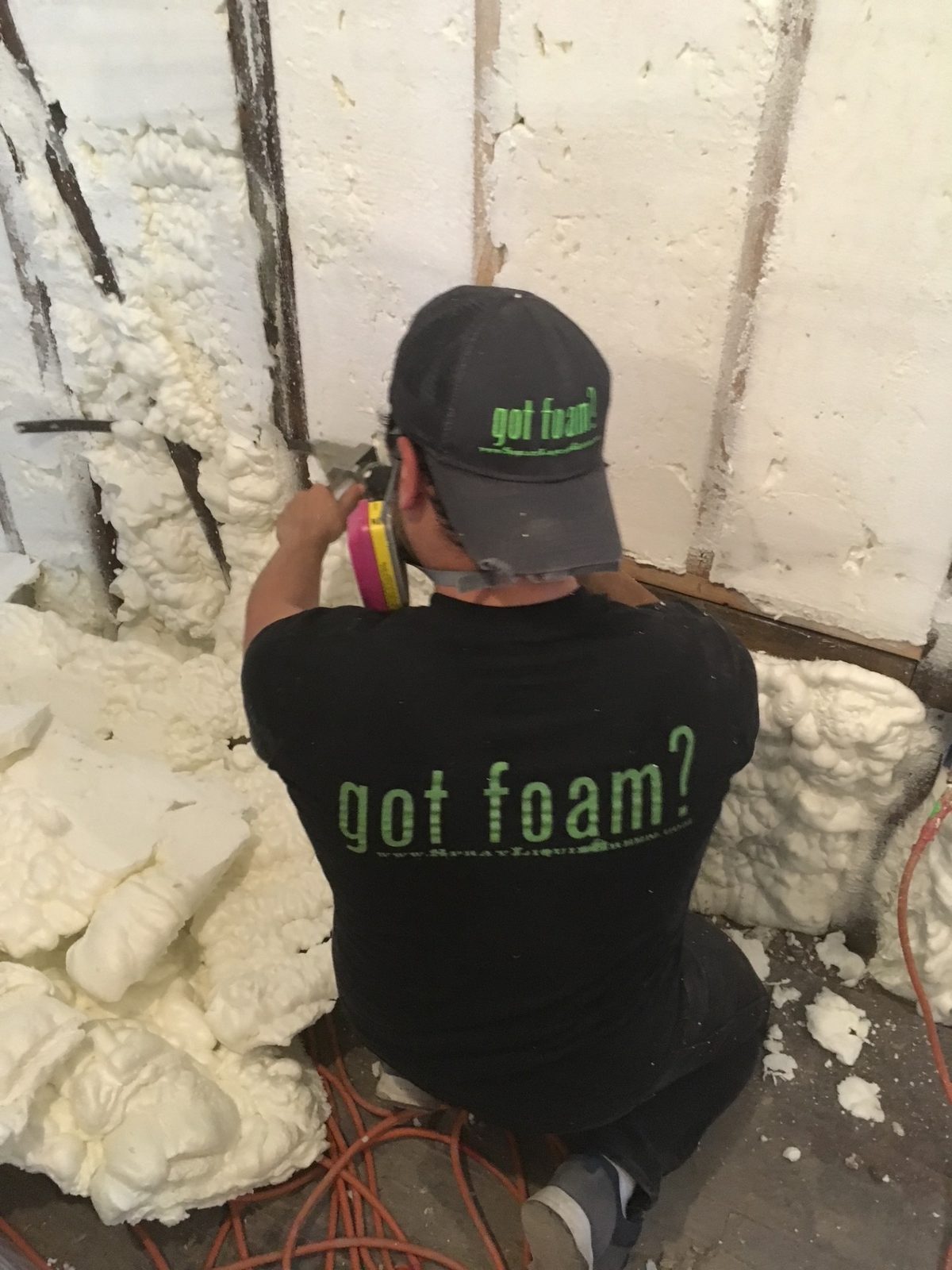
As a Liquid Green franchisee, you operate a mobile spray foam insulation business in a defined protected territory. The business model is built around three core activities:
Residential insulation. New construction and retrofit installations in single-family homes — attics, walls, basements, crawl spaces, rim joists.
Commercial insulation. New construction and retrofit installations in commercial buildings — offices, warehouses, retail, agricultural structures, institutional facilities.
Specialty applications. Rim joists, cathedral ceilings, bonus rooms, metal buildings, pole barns — projects where spray foam's air-sealing and high R-value solve problems other insulation can't.
The mobile business model means no storefront is required. You operate from your truck, with scheduled jobs dispatched through the included CRM.
How is a franchise different from starting my own spray foam business?
Starting a spray foam business independently means you have to figure out everything yourself — equipment selection, application technique, pricing, marketing, sales pipeline, regulatory compliance, accounting systems, and brand. A franchise gives you a tested system for all of that from day one.
Concretely, a Liquid Green franchise includes:
The equipment package selected for residential and commercial work.
The complete training program (20 hours classroom + 20 hours hands-on) so you can apply foam correctly on day one.
The CRM platform configured for spray foam lead tracking, quoting, and job management.
The brand guidelines, marketing templates, and website framework so you don't start from a blank page.
The HQ onboarding (1-2 weeks in Brewster, NY) where you learn the playbook directly from ownership.
Ongoing operational support after launch.
You still own and operate the business — the franchise gives you the system, not the operator.
What is a Franchise Disclosure Document (FDD)?
The FDD is a legal document required by the U.S. Federal Trade Commission (FTC) for any franchise offered for sale in the United States. It contains 23 specific items of information about the franchisor, the franchise system, the costs, the obligations of both parties, and the financial performance representation (if any).
Before any franchise agreement is signed, the FTC requires that the prospective franchisee receive the FDD and have a minimum of 14 calendar days to review it before any payment or signing.
Liquid Green provides its full FDD to every qualified applicant before any commitment is requested. The FDD is the authoritative source for investment ranges, fees, obligations, and the legal terms of the franchise relationship — anything in marketing material should be read in light of the FDD.
What is Item 19, and why does it matter?
Item 19 of the FDD is the section that contains the franchisor's financial performance representation — meaning any historical or projected sales, costs, or earnings figures for existing franchise locations.
Item 19 is the only place in the FDD where a franchisor can make a financial performance claim, and only if it includes specific substantiation and complies with FTC rules.
Liquid Green does not currently make an Item 19 financial performance representation. Any claim about what a franchisee will earn, what revenue they will generate, or how long until they reach any particular sales level should be treated as not implied or guaranteed. Actual results vary and there are no assurances you will achieve any particular outcome.
This is consistent with FTC franchising best practice for emerging systems: don't promise what you haven't yet substantiated.
What's the difference between a franchise and a licensing/dealer model?
In a franchise, the franchisor provides a complete operating system — brand, training, ongoing support, marketing, technology — in exchange for fees and ongoing royalties. The franchisee operates under the franchisor's brand and system.
In a licensing or dealer model, the parent company typically provides only the right to sell a product, with much less support. The operator keeps their own brand and runs independently.
Spray foam insulation lends itself to a franchise model because the technical application requires consistent training, the equipment is specialized, and customers benefit from a recognizable brand they can trust.
What You Need to Know (and What You Don't)
One of the most common misconceptions about spray foam is that you need years of experience to start. Here's the truth about the training and background requirements.
Do I need spray foam experience to start?
No. Prior spray foam experience is not required to build a successful Liquid Green territory.
The complete training program is designed to take motivated first-time operators from zero application knowledge to confident, independent operation. You'll learn equipment setup, chemical handling, spray technique for different substrates (open stud walls, closed cavities, attic floors, rim joists, roof decks), safety procedures, and quality control.
What matters more than specific experience is: willingness to learn a physical skill, comfort with the basic math of running a service business (estimating, quoting, margin), and the discipline to follow a proven system. The training covers the rest.
What if I've never run a business before?
Many Liquid Green franchisees come from non-business backgrounds — trades, military, sales, manufacturing, or other careers. The franchise model is specifically designed to be run by motivated first-time operators.
The HQ onboarding (1-2 weeks in Brewster, NY) covers the business operations side: estimating, quoting, scheduling, customer communication, basic financial tracking, and using the included CRM to manage leads and jobs.
You don't need an MBA. You need to be coachable, organized, and willing to work a seasonal physical schedule.
What does the training program actually cover?
The complete training program has two parts:
20 hours of classroom training — covers:
Spray foam chemistry and the difference between open-cell and closed-cell; equipment overview, setup, and routine maintenance; safety procedures, PPE, and ventilation requirements; building science basics (vapor barriers, thermal bridging, air sealing, condensation control); estimating, quoting, and pricing strategies; sales process and customer communication; marketing fundamentals and lead generation; regulatory and code compliance.
20 hours of hands-on training — covers:
Equipment operation under real conditions; spray technique on different substrates (stud walls, rim joists, attics, roof decks); quality control (achieving proper density, adhesion, and uniform coverage); troubleshooting common application issues; safety drills with PPE.
The full onboarding is completed over 1-2 weeks at our HQ in Brewster, NY.
Do I need construction experience?
Construction experience is helpful but not required. Many successful spray foam operators come from non-construction backgrounds.
What helps most: comfort working with your hands, basic mechanical aptitude, willingness to learn building science, and the physical ability to handle the equipment (the spray rig and hoses are substantial — you'll be moving around a job site all day).
The training program covers the construction-adjacent knowledge you need: how buildings are framed, what a rim joist is, how attics are vented, what the vapor barrier does, and how to read a simple plan set.
Is there ongoing support after the initial training?
Yes. The training is the start, not the end. After launch, Liquid Green HQ provides:
Operational support for technical questions (chemistry, equipment, application issues); marketing support and brand updates; CRM platform updates and training refreshers; peer community with other operators in the system.
You're in business for yourself, but not by yourself.
What the Money Actually Buys
The investment range and what it includes. The FDD is the authoritative source — this is the plain-English version.
What is the total startup investment?
The total startup investment for a Liquid Green spray foam franchise ranges from $136,000 to $194,000.
This is significantly lower than many major insulation franchises that often exceed $200,000 to $500,000+ in startup costs. The lower entry point is part of the mobile business model — no storefront, no large facility, no franchise territory fees layered on top.
The exact figure for any individual franchisee depends on the specific equipment package selected, the vehicle condition, working capital needs, and the territory. The FDD provides the detailed Item 7 breakdown.
What does the investment include?
The investment covers everything you need to open for business:
Equipment package — the spray rig, proportioner, hoses, gun, and application tools configured for residential and commercial work.
Initial inventory — drums of spray foam chemical, primers, and consumables to cover your first jobs.
Training — the 20-hour classroom + 20-hour hands-on program and 1-2 week HQ onboarding (no separate tuition).
Brand and marketing — initial brand assets, website framework, marketing templates.
Technology — CRM platform configured for spray foam lead and job management.
Launch support — operational support during your first 30-60 days.
Working capital — reserve funds to cover operating expenses during the ramp-up period.
Are there ongoing fees after the initial investment?
Yes — the franchise model includes ongoing fees, which are disclosed in detail in the FDD (Item 6). The two standard ongoing fees in franchising are:
Royalty fee — a percentage of gross sales, paid to the franchisor for continued use of the system, brand, and support.
Marketing or brand fund contribution — a percentage of gross sales (or fixed amount) pooled for system-wide marketing.
Specific rates and terms are in the FDD. Liquid Green's fee structure is transparent and disclosed up front — there are no hidden national advertising costs or surprise assessments.
What about financing?
Liquid Green does not directly finance franchisees. The FDD (Item 10) discusses financing sources, and the franchise team can share information about:
SBA (Small Business Administration) loans — the most common financing route for franchise startups.
Conventional bank loans and lines of credit.
Equipment financing for the spray rig and tools.
Home equity lines of credit (for owners with substantial home equity).
Rollovers as Business Startups (ROBS), where applicable.
Most franchisees fund a portion from personal savings or retirement accounts and the balance through a combination of the above. Liquid Green does not guarantee financing or represent that any particular financing source will be available.
Are there any hidden costs I should know about?
No. The Liquid Green fee structure is straightforward. The total startup investment, the royalty rate, and the marketing contribution are all disclosed in the FDD before you sign anything.
What you should budget beyond the franchise investment, depending on your situation:
Vehicle purchase or lease (if you don't already have a suitable truck); business insurance (general liability, commercial auto, workers' comp when you hire); local business licensing and any required trade permits; personal living expenses during the ramp-up period (typically 3-6 months); fuel, vehicle maintenance, and per-job consumables as you operate.
These are normal small-business costs, not franchise-specific fees. The franchise team will walk through realistic operating budgets during the discovery process.
Where You Work and How the Day Runs
Territory definition, daily operations, equipment, and the practical question of how the business actually runs day to day.
How are territories defined?
Territories are defined by population, demand, and proximity to other franchisees. A territory is typically scoped as a geographic area — a county, a multi-county region, or a metropolitan service area — sized to provide enough addressable market for one operator to build a sustainable business.
The exact territory size and shape is negotiated with each franchisee based on local market conditions. A dense urban metro area will be a smaller geographic territory than a spread-out rural region, because the addressable market is concentrated.
Can I choose my own territory?
Yes — within availability. You tell us where you want to build, and we work with you to define a protected territory that fits the market. We consider:
Population and addressable housing stock in the area; existing construction activity (new builds, retrofits); climate and seasonal work patterns; proximity to existing franchisees (so territories don't overlap); your own background and any local market knowledge.
If your preferred area is already taken, we'll work with you to identify the best alternative market.
Is the territory protected?
Yes. Each Liquid Green franchisee is assigned a protected territory, giving you exclusive rights to operate within a defined geographic area. No other Liquid Green franchise will be placed inside your territory.
The protected territory is a core part of the franchise model and is documented in the franchise agreement. It supports long-term growth by preventing intra-brand competition.
Protected territory is subject to availability and operator performance, as disclosed in the FDD.
Can I own multiple territories?
Yes. Multi-territory ownership is available for operators who want to grow a larger regional business over time. The model is built for scalability.
Adding a second territory is subject to availability, performance, and HQ approval. Many operators who start with a single territory add a second within 2-3 years once the first is stable.
Do I need a storefront or office?
No. The Liquid Green model is built around a mobile operation:
You operate from your truck and equipment trailer; jobs are scheduled through the included CRM; the "office" is wherever you can take a call and write a quote — a home office, a coworking space, or a coffee shop.
This significantly reduces overhead compared to a fixed-location franchise. No rent, no utilities for a separate facility, no showroom buildout.
What does a typical day look like?
Spray foam work is seasonal in most of the U.S. (busier in warmer months when attics and walls are easier to access without heating concerns; slower but still active in cold months on interior and commercial projects).
A typical work day for an owner-operator:
Morning: Drive to the job site, set up equipment, confirm the job scope with the customer.
Mid-day: Spray — the actual application work, which takes a few hours per typical residential job.
Afternoon: Clean up, demobilize, drive to the next job or back to base.
End of day: Quote new leads, follow up with prospects, update the CRM, plan tomorrow's schedule.
As the business grows, the operator typically hires a first crew member and shifts into more of a sales/QC/project-management role.
How do I find customers?
Lead generation is a mix of strategies, and the franchise includes a marketing framework to get you started:
Referrals — past customers, builders, general contractors, and real estate agents. Referrals are typically the highest-converting lead source in residential trades.
Builder relationships — new-construction insulation contracts with home builders and general contractors in your territory.
Online presence — local SEO, Google Business Profile, and a territory website (framework provided).
Home shows and trade events — local visibility.
Direct outreach — to property managers, HOAs, and commercial building owners.
The included CRM tracks leads, quotes, and conversions so you know which channels are producing results and where to invest more effort.
What marketing support is provided?
The franchise includes initial marketing assets and a system-level framework:
Brand guidelines and visual identity; marketing templates (digital and print); website framework for your local territory; CRM configured for lead management and follow-up; ongoing brand updates and seasonal campaign assets.
Local marketing execution — the actual ads, mailers, door hangers, SEO work, etc. — is your responsibility as the local operator. The framework gives you a head start; running it is the operator's job.
From Curiosity to Grand Opening
The actual process from first contact through opening your doors. Realistic timelines and what each step involves.
What's the first step?
The first step is a short conversation with the franchise team to confirm there's a fit on both sides. This is not a commitment — it's a 15-20 minute call to:
Hear about your background and what you're looking for; confirm the Liquid Green model aligns with your goals; answer initial questions; determine whether to move forward to a deeper discovery conversation.
If both sides want to keep talking, the next step is a more detailed discovery conversation and review of the FDD.
How long does the whole process take?
A realistic timeline from first inquiry to grand opening is typically 3-6 months, depending on:
How quickly you can review the FDD and complete due diligence; financing timeline (SBA loans can take 60-90 days); territory confirmation and finalization; training scheduling (1-2 week HQ onboarding); vehicle and equipment readiness; local licensing and business setup.
Most of the time is spent on financing and licensing — the franchise system itself is designed to move efficiently once you're committed.
What happens after I submit an inquiry?
Typical next steps after an initial inquiry:
Initial call — 15-20 minute fit conversation with the franchise team.
Discovery conversation — deeper discussion of the model, your background, the territory you're interested in, and the investment.
Territory confirmation — we work with you to define and confirm your protected territory.
Receive the FDD — full Franchise Disclosure Document delivered for your review.
14-day review period — minimum review time required by FTC before signing.
Discovery day — optional in-person or virtual visit with the HQ team to validate the fit.
Financing — finalize your funding (savings, SBA loan, etc.).
Sign the franchise agreement.
Training — 1-2 week HQ onboarding.
Launch — equipment, vehicle, CRM, marketing, first jobs.
Can I talk to current franchisees?
Yes. During the discovery process, the franchise team can arrange conversations with existing Liquid Green operators (or the founder's prior operations team) so you can hear directly what the day-to-day is like and what the experience has been.
This is a standard part of due diligence on both sides — you should be confident before you commit, and the team wants to make sure the model is the right fit for you.
What questions should I ask during discovery?
Good questions to bring to the discovery conversation:
What does the equipment package include, and what's the expected lifespan?; How are territories sized and what's typical for a market like the one I'm interested in?; What's the current equipment-to-operator ratio for a single crew?; What's the seasonal pattern in my target market?; How does the CRM track leads from first contact to closed job?; What does the first-year ramp typically look like?; What ongoing support is included after launch?; What marketing channels work best in the early months?; What happens if I want to exit the business — is there a resale process?
And of course, anything specific to your own situation — your background, your target market, your financing plan, your timeline.
Can I visit the HQ before committing?
Yes. A discovery day at the Liquid Green HQ in Brewster, NY is encouraged. You'll see the operation, the equipment, the training facility, and meet the team. Many prospective franchisees find this invaluable for validating the fit.
Travel and accommodation are at your own expense, but the day itself is hosted by the HQ team at no charge.
Let's Talk
If these answers helped, the next step is a short conversation with the franchise team to confirm fit, talk through your market, and review the FDD together.
Start the Conversation Back to Franchising