Pennsylvania — Spray Foam Insulation Territory Opportunities
Pennsylvania spray foam insulation territory opportunities for franchise investment — seven metros, multi-climate zones, older housing stock, and a structural home efficiency tailwind across the Keystone State.
Why Pennsylvania Is a Strong Market for Spray Foam Insulation
Pennsylvania is the fifth-largest state in the country by population, with approximately 13 million residents spread across seven distinct regional metros. Philadelphia and the southeastern counties anchor the east. The Lehigh Valley (Allentown, Bethlehem, Easton) is one of the fastest-growing metros in the state. Harrisburg and the Susquehanna Valley run up the center. Scranton and the Wyoming Valley cover the northeast. Pittsburgh and the southwest have their own self-contained economy. State College and the central PA counties tie the I-80 corridor, and Erie anchors the northwest on Lake Erie. That scale creates one of the most attractive spray foam insulation territory opportunities in the country — and a compelling franchise investment case for a multi-unit operator or area developer.
Geographically, the state spans three or more IECC climate zones — warmer along the southeastern border, colder in the Poconos and the northwest, and high-elevation cold in the Allegheny Plateau. That diversity is a feature, not a bug: four-season demand in most markets, with the colder zones producing the strongest heating-degree-day economics for insulation work. The state has a four-season install window in most regions, and a robust builder base that runs year-round. The investment in a Pennsylvania spray foam insulation territory gives the operator a year-round platform.
The other Pennsylvania feature is the housing stock. The median age of owner-occupied homes in the state is around 60 years, per the most recent U.S. census data. A large share of homes were built before modern energy codes — pre-1970s construction with little or no insulation, single-pane windows, and significant air leakage. Each of those homes is a candidate for a deep energy retrofit, and the older the home, the bigger the energy savings from a high-performance spray foam insulation install. The retrofit pipeline is decades long, and the home efficiency tailwind is real.
Construction Opportunities for Spray Foam Insulation in Pennsylvania
Pennsylvania's construction market is one of the largest and most diverse in the country, and the construction opportunities for spray foam insulation operators are continuous. Philadelphia and the southeastern counties anchor residential new construction, additions, mixed-use, and institutional work, with major universities (Penn, Temple, Drexel), healthcare systems, and a steady stream of public projects. The Lehigh Valley is one of the fastest-growing metros in the state, with new construction opportunities in residential, multifamily, and industrial categories. Pittsburgh and the southwest have their own construction economy, anchored by UPMC, Allegheny Health Network, the universities (Pitt, Carnegie Mellon, Duquesne), and the rust-belt retrofit market.
The construction opportunities for spray foam insulation in each metro are different. Harrisburg and the Susquehanna Valley run a steady mix of residential, light commercial, and state-government capital projects. Scranton and the Wyoming Valley have a similar retrofit profile to Pittsburgh, with older homes and steady builder activity. State College and the central PA counties tie to Penn State, the largest single employer in the region, and the construction opportunities for spray foam insulation in student housing, academic buildings, and energy efficiency retrofits are continuous.
Institutional construction is a deep construction opportunity for spray foam insulation operators. The state-related university system — Penn State, the University of Pittsburgh, Temple, and Lincoln — generates continuous capital projects. K-12 construction, healthcare capital projects, and state agency infrastructure add to the pipeline. A Pennsylvania franchise investment develops sub-territories for each major metro, with both residential and commercial construction opportunities in the mix, and the green building and home efficiency standards drive the envelope specification on every project.
Home Efficiency & Green Construction Demand in Pennsylvania
The home efficiency tailwind in Pennsylvania is real and layered. The state-related university system, the PA weatherization assistance program (WAP), LIHEAP, and the utility rebate portfolios together create a green construction market that runs deep. The home efficiency and green construction market in Pennsylvania is structural, not cyclical, and spray foam insulation is the highest-R-value-per-inch common insulation product on the market — the natural answer to PA envelope requirements and green building standards.
The green construction demand extends well beyond code. The PA weatherization assistance program (administered through the Department of Community and Economic Development) funds free insulation, air sealing, and HVAC upgrades for income-eligible households. LIHEAP runs federally through PA's Department of Human Services and helps income-eligible households pay heating bills and fund envelope upgrades. The combination of weatherization funding, federal tax credits, and utility rebates stacks the financing for the homeowner in a way that closes more bids at full price.
On the utility side, PPL Electric Utilities, Met-Ed (a FirstEnergy company), PECO Energy, Duquesne Light, and Penelec each administer energy efficiency programs that include insulation and air-sealing rebates. The statewide building code is based on the 2018 or 2021 IECC, with R-value and air-sealing requirements that point at spray foam insulation as a high-performance solution. Federal 25C and 25D tax credits stack on top of state and utility incentives, putting thousands of dollars back into the homeowner's pocket. Green building codes, green construction incentives, and green construction market demand together create the structural tailwind for spray foam insulation operators in Pennsylvania.
Job Opportunities Created by a Pennsylvania Spray Foam Franchise
A Pennsylvania spray foam franchise creates local job opportunities in every sub-territory. A statewide development agreement is structured to build a regional platform, and that platform creates the job opportunities that scale with the operator's growth. The entry-level role is the spray foam technician — a skilled trades position with on-the-job training through the Liquid Green Spray Academy. The 20-hour Spray Academy covers application technique, safety, equipment, and code. The 1–2 week HQ onboarding at Brewster covers the operational side. No experience is required to start.
As the franchise grows, the job opportunities multiply. Crew leads, estimators, and operations support staff come next. A statewide development adds regional managers, sub-franchisee recruiting roles, and dedicated training capacity. The job opportunities for applicators and crew members are year-round, full-time, and stable — not seasonal gig work. The job opportunities the franchise creates pay above the local average for entry-level work, with real benefits and a clear career path. Each new sub-territory adds more local job opportunities in the spray foam insulation industry and in the home efficiency and green construction market.
Pennsylvania has a strong work ethic and trades culture. The job opportunities stay local. Every spray foam insulation installation is performed in a neighborhood, on a building, by a local crew. The job opportunities in construction, in skilled trades, in energy efficiency, and in home efficiency retrofits are the work opportunities the franchise model is built to create. The community gets the jobs, the operator gets the business, and the franchise investment pays back across a regional platform. Results vary by operator and market — but the local job opportunities are real from day one.
Investment & What's Included in a Pennsylvania Territory
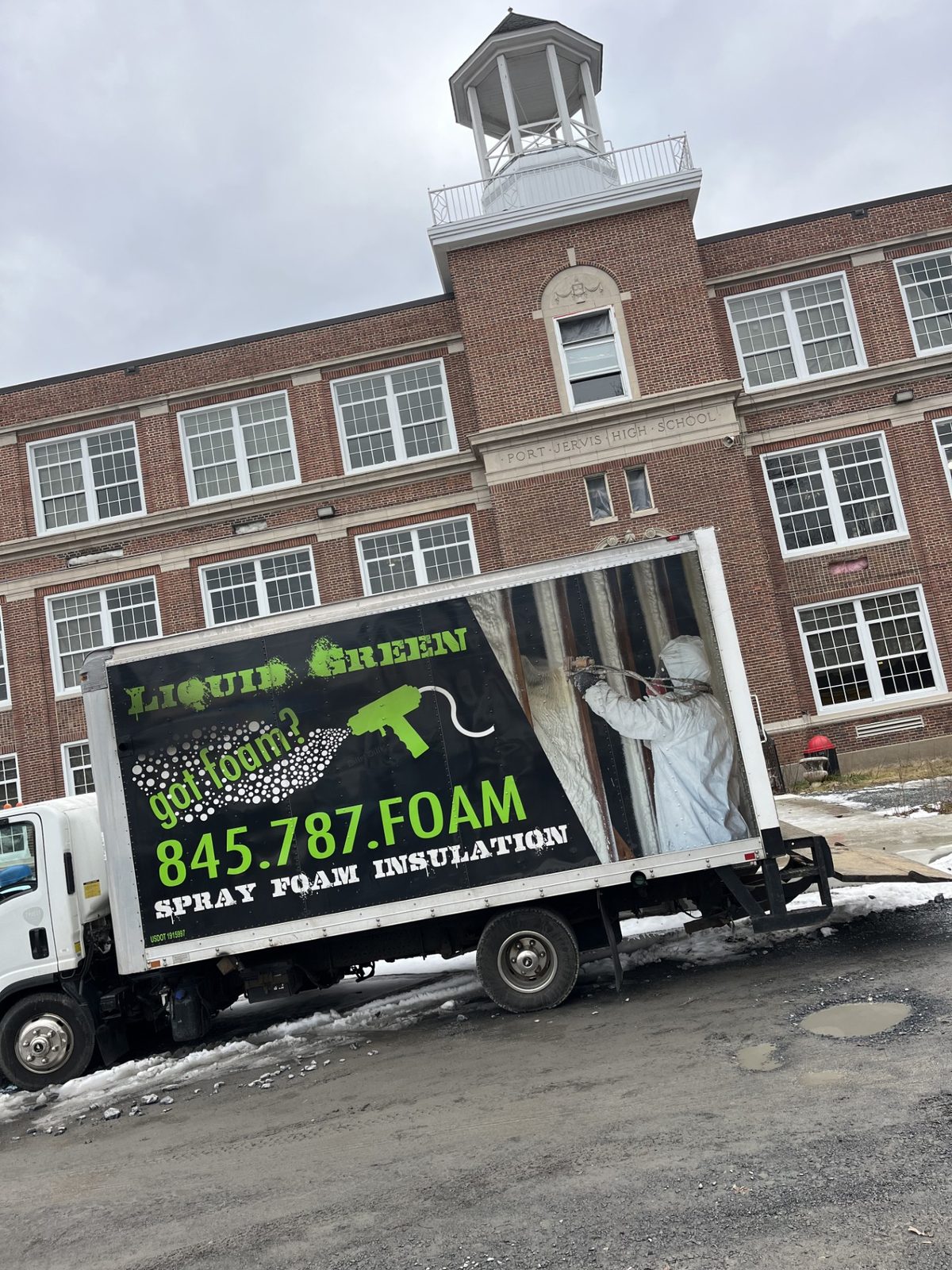
The investment for a Liquid Green Pennsylvania spray foam insulation territory is $136,000 to $194,000 all-in. The investment covers the franchise fee, the mobile spray foam insulation rig, the proportioner and gun package, initial chemical inventory, branding and vehicle wrap, the 20-hour Liquid Green Spray Academy, 1–2 weeks of HQ onboarding at Brewster, CRM access, the operating playbook, and 90 days of working capital. The investment covers everything the operator needs to launch, run the first jobs, and establish a local reputation in the spray foam insulation, home efficiency, and green construction market.
Treat the investment range as a planning benchmark, not a single number. Actual startup cost varies by rig configuration, vehicle choice, and working capital cushion. Results vary by operator and market. Liquid Green's fee structure is transparent — no hidden marketing co-op deductions, no required national ad-spend tiers. The full Item 7 cost breakdown lives in the Franchise Kit. For a multi-unit operator or area developer, the per-unit investment scales with the development schedule and the equipment mix.
The investment is the entry ticket; the system is the asset. The operating system, the brand, the training, the playbook, and the support team are what make the investment work. Industry estimates for spray foam insulation demand should be treated as benchmarks, not promises. No prior spray foam insulation experience is required. If the Pennsylvania territory opportunity looks like a fit, the next step is the Franchise Kit.
Pennsylvania Territory — Common Questions
How much does a Liquid Green franchise cost in Pennsylvania?
Initial investment is $136,000 to $194,000 all-in. The investment covers the franchise fee, the mobile spray foam insulation rig, equipment, initial inventory, training, HQ onboarding in Brewster, and 90 days of working capital. Treat the investment range as a planning benchmark, not a single number — actual startup cost varies by rig configuration, vehicle choice, and working capital cushion. Results vary by operator and market. Liquid Green's fee structure is transparent: no hidden marketing co-op deductions, no required national ad-spend tiers. See the Franchise Kit for the full Item 7 cost breakdown.
What spray foam insulation construction opportunities are in Pennsylvania?
The construction opportunities for spray foam insulation in Pennsylvania are continuous and varied across seven metros. Philadelphia and the southeastern counties anchor new construction, additions, and institutional work. The Lehigh Valley (Allentown, Bethlehem, Easton) is one of the fastest-growing metros for residential and light-commercial construction. Pittsburgh and the southwest run a steady mix of residential, healthcare, and rust-belt retrofit. Harrisburg, Scranton, Erie, and State College round out the pipeline. The construction opportunities for spray foam insulation span residential, commercial, and institutional categories, and a single franchise territory covers all of it.
What home efficiency and green construction incentives apply in Pennsylvania?
Pennsylvania runs a layered set of home efficiency and green construction programs. The PA weatherization assistance program (WAP) and LIHEAP fund free insulation, air sealing, and HVAC upgrades for income-eligible households. PPL, Met-Ed, PECO, Duquesne Light, and Penelec each administer utility rebate programs for insulation and air-sealing work. The statewide building code is based on the 2018 or 2021 IECC, with R-value and air-sealing requirements that point at spray foam insulation. Federal 25C and 25D tax credits stack on top of state and utility incentives, putting thousands of dollars back into the homeowner's pocket for a high-performance spray foam insulation job.
What job opportunities does a Pennsylvania territory create?
A Pennsylvania spray foam insulation territory creates local job opportunities in every sub-territory. The job opportunities for applicators, crew leads, estimators, and operations staff scale with the operator's growth. A statewide development adds regional managers, sub-franchisee recruiting roles, and dedicated training capacity. Job opportunities in the spray foam insulation industry are year-round, full-time, and stable — not seasonal gig work. Each new sub-territory brings its own local hiring, and every job opportunity stays in the community where the franchise operates. The job opportunities the franchise creates are skilled trades positions that pay above the local average for entry-level work, with on-the-job training through the Liquid Green Spray Academy.
Do I need spray foam insulation experience?
No. No spray foam insulation experience is required. Most Liquid Green franchisees come from outside the trades — sales, military, manufacturing, HVAC, project management. The 20-hour Liquid Green Spray Academy covers the technical side (application, equipment, safety, code), and the 1–2 week HQ onboarding in Brewster covers the operational side: rig setup, scheduling, customer acquisition, builder relationships, and the first jobs. The operating system is the product, not just the spray foam insulation. You bring the hustle; we bring the playbook.
Get the Franchise Kit
Investment details, training overview, territory map, development schedule, and the full FDD process — all in one kit. We'll send it within 24 hours.
Get the Franchise Kit Back to Opportunities