New Haven County, CT — Western CT Market Detail
Market detail for New Haven County — one of three counties in the Liquid Green Spray Foam Western Connecticut franchise territory.
Note: This page is market detail for the Western Connecticut franchise territory — not a separate opportunity. The full Western CT territory covers Fairfield, Litchfield, and New Haven counties as a single protected franchise.
Why New Haven County, CT Is a Strong Franchise Market
New Haven County is the opposite of Litchfield — high density, high population, and a housing stock that spans more than a century of construction. Per the most recent U.S. Census estimates, the county has approximately 860,000 residents, making it the third-largest county in Connecticut. It is anchored by New Haven (CT's second-largest city), plus Waterbury, Meriden, Milford, and a ring of suburbs and Shoreline towns.
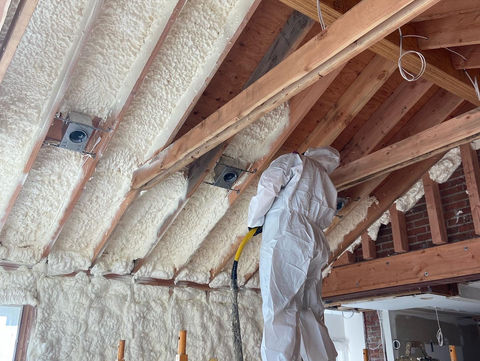
For a spray foam operator, that density is leverage. Short drive times between jobs, multiple bids a day, and a crew that can knock out two or three attic retrofits in the same neighborhood on the same day. The Shoreline towns — Guilford, Madison, Branford, North Branford — and the I-84/I-91 corridor add new-construction and addition work on top of the city retrofit base.
What makes the market especially durable is the housing diversity. New Haven city has 1920s triple-deckers sitting next to 1960s ranches, often in the same block. That stock variation produces retrofit demand in every season: attic and rim-joist work in winter, wall-cavity injection in spring and fall, full envelope upgrades in summer. Waterbury and Meriden are similar — older housing, lots of multifamily, a deep pipeline of energy-efficiency work. The same investment range delivers more jobs per month and a faster route to a full job book, with the trade-off being tighter scheduling and a system for handling commercial and institutional work alongside residential. That is what the Liquid Green operating system is built for.
Construction Industry & New Build in the New Haven Market
Connecticut's residential construction market runs above the long-term average in dollar terms, and New Haven County carries a meaningful share. Per the most recent CT Department of Labor data, the construction industry in the New Haven labor market area remains one of the largest employment sectors in the region, with new single-family and multifamily permits concentrated in Cheshire, Wallingford, Milford, and the Shoreline.
New construction skews suburban — subdivisions in Cheshire, infill single-families in Wallingford and North Haven, custom homes along the Shoreline, and a steady pipeline of multifamily in New Haven and Waterbury. Spray foam is increasingly specified by local builders because closed-cell rooflines and open-cell attic floors deliver the R-value the energy code now requires.
The institutional and commercial work is real too. Yale, Southern Connecticut State, Yale-New Haven Health, and a long list of public and private employers in the I-95 and I-91 corridors generate ongoing capital projects. Yale and SCSU are anchors for institutional work that a New Haven operator can build long-term relationships around. The referral loop is tight — design-build firms, architectural firms, and GCs all know each other. Reputation compounds fast across the local construction community.
Energy Efficiency Tailwind in South-Central Connecticut
Connecticut residential electricity rates are among the highest in the continental United States, and natural gas heating costs along the I-91 corridor have moved up steadily over the last decade. The utilities serving New Haven County — Eversource and United Illuminating (UI) — both run robust energy-efficiency programs through Energize CT, with rebates for residential and commercial insulation and air sealing.
Those rebates stack with the federal Energy Efficient Home Improvement Credit (25C) and the Residential Clean Energy Credit (25D) into a meaningful customer incentive. The operator who can clearly explain the rebate-and-credit stack tends to close at a much higher rate — part of the Liquid Green sales process. The customer sees the math, the math works, and the close follows.
Connecticut's 2022 IECC update raised ceiling and wall R-value targets and tightened the building envelope further, so the code floor keeps moving up. Spray foam is the highest-R-value insulation per inch of any common product, and it air-seals at the same time. In a county with this much pre-war housing stock, the gap between current performance and code performance is enormous — and that gap is the operator's market. Industry estimates put spray foam demand in the U.S. growing at high single digits year over year. Your results will depend on how you run the business — but the tailwind is real.
Local Work, Local Jobs, Hometown Business
This is a hometown business, even in a big county. The franchise operator is the face of the company at Wooster Square, the St. Patrick's Day parade in Waterbury, the Durham Fair, the Guilford Fair — and at every job site in between.
Most operators start with a small install crew — a lead installer and a helper — and add crew as the job book grows. Crew members are full-time W-2 employees with on-the-job training in spray application, PPE, and customer communication. Hiring locally is a core part of the model: New Haven, Waterbury, Meriden, Milford, and Shoreline jobs for local people, on local homes and small businesses.
Over time, the footprint grows. A successful operator adds a second rig, a second crew, an estimator, and a customer service / office person — real job creation in the neighborhoods where the operator lives, sends their kids to school, and pays property taxes. For operators who want a high-density market, New Haven County is a strong fit. Reputation compounds fast.
Investment & What's Included
Total startup investment for a Liquid Green franchise in New Haven County ranges from $136,000 to $194,000 — the all-in: franchise fee, mobile spray rig, proportioner, hoses and gun, generator, initial chemical inventory, PPE, truck branding, CRM access, training, the 1–2 week HQ onboarding in Brewster, and working capital. There are no hidden national advertising co-op deductions and no required minimum ad-spend tiers. The fee structure is transparent and disclosed in the FDD.
What's included:
- Protected territory: the entire county is yours. No other Liquid Green operator inside New Haven County.
- Mobile rig and equipment package: for the Northeast.
- 20-hour Spray Academy: classroom and hands-on.
- 1–2 week HQ onboarding in Brewster: shadowing the flagship crew.
- CRM, marketing assets, brand guidelines: the operating system is the product
- Ongoing operational support: direct line to the franchise team and to founder Harvey Barnes.
Plan for a range, not a single number. The high end covers a fully-spec'd second-generation rig and a larger initial chemical inventory; the low end covers a leaner launch. Either way, the all-in is below what most major insulation franchises require, and the operating system is the same one the Brewster flagship runs on. If New Haven County looks like a fit, the next step is the Franchise Kit — full Item 7, territory map, sample economics treated as benchmarks not promises, and a clear path to the discovery call. Got Foam?
New Haven County, CT — Common Questions
How much does a Liquid Green franchise cost in New Haven County?
Initial investment ranges from $136,000 to $194,000, which includes the franchise fee, the mobile spray foam rig, equipment, initial inventory, training, and working capital. Liquid Green's fee structure is transparent — no hidden marketing co-op deductions, no required national ad spend tiers. See the Franchise Kit for the full Item 7 cost breakdown.
What does the New Haven County, CT territory include?
The New Haven County territory is a single-county protected franchise area covering all of New Haven County, CT — including New Haven, Waterbury, Meriden, Milford, Hamden, West Haven, East Haven, Cheshire, Wallingford, North Branford, North Haven, Bethany, Woodbridge, Orange, Guilford, Madison, Branford, and Northford. No other Liquid Green operator will be placed inside these borders.
Do I need construction or spray foam experience?
No. Most of our franchisees come from outside the trades — sales, military, manufacturing, HVAC, project management. The 20-hour Liquid Green Spray Academy covers the technical side, and the 1–2 week HQ onboarding in Brewster covers the operational side: rig setup, scheduling, customer acquisition, and the first jobs. The operating system is the product, not just the foam.
What's the local construction market like in New Haven County?
New Haven County is Connecticut's third-largest county by population, with approximately 860,000 residents. The housing stock is unusually diverse — New Haven city has 1920s triple-deckers sitting next to 1960s ranches, often in the same neighborhood — and that mix drives a deep retrofit market. New construction is steady in the suburban towns along the Shoreline and in the I-84/I-91 corridor. Yale University and Southern Connecticut State University anchor a strong institutional and commercial work pipeline.
What kind of jobs will my franchise create?
Local work for local hires. Operators typically start with a small install crew (a lead installer and a helper) and grow from there as job volume picks up. Crew members are full-time W-2 employees with on-the-job training in spray application, safety, and customer service. Hiring locally is a core part of the model — these are hometown jobs across New Haven, Waterbury, Meriden, and the Shoreline, not traveling crews.
Get the Franchise Kit
Investment details, training overview, territory map, sample economics, and the full FDD process — all in one kit. We'll send it within 24 hours.
Request the Franchise Kit Back to Western CT