Connecticut — Spray Foam Insulation Territory Opportunities
Connecticut territory opportunities for the Liquid Green Spray Foam franchise span the Constitution State — Hartford, New Haven, Stamford, Bridgeport, Norwalk, Danbury, the Litchfield Hills, the Quiet Corner, and the Connecticut River Valley. A year-round spray foam insulation market with premium pricing, multi-unit investment scale, and a structural home efficiency and green construction tailwind.
Why Connecticut Is a Strong Market for Spray Foam Insulation
Connecticut is a small, dense, high-income state with an outsized demand profile for residential and commercial spray foam insulation. Approximately 3.6 million residents live in roughly 5,500 square miles, and the state posts the highest median household income in the country at around $90,000 per the most recent U.S. Census Bureau data. For a franchise operator, that combination is rare: dense geography, premium pricing power, and a four-season climate that runs heating and cooling loads year-round.
The territory opportunities inside Connecticut break into distinct regional markets. Hartford and the Capitol Region anchor the center. New Haven and the shoreline towns run along Long Island Sound. Stamford, Norwalk, Bridgeport, and Danbury make up the Fairfield County corridor with New York metro spillover. The Litchfield Hills cover the northwest with historic colonials, equestrian properties, and high-end new construction. The Quiet Corner in northeast CT and the Connecticut River Valley add agricultural, small-town, and mid-density markets. Each is a sub-territory candidate in a Connecticut spray foam insulation build.
The state sits in IECC climate zone 5A across most of the territory, with cold winters and hot, humid summers. Both heating and cooling loads drive insulation demand, which is why spray foam insulation — the highest-R-value-per-inch product on the market — is the technical answer in nearly every Connecticut home, addition, and retrofit. Industry estimates put U.S. spray foam insulation demand growth at high single digits year over year.
Construction Opportunities for Spray Foam Insulation in Connecticut
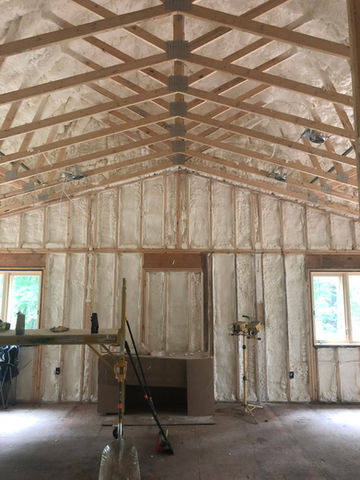
The construction opportunities for spray foam insulation in Connecticut run across every project type, in every county, all year. The state has a continuous pipeline of residential new construction, additions, major renovations, and tear-down-and-rebuild projects — particularly in Fairfield County and the Litchfield Hills, where high-end custom homes and additions command premium spray foam insulation budgets. Coastal towns along Long Island Sound mix year-round residences, second homes, and post-storm rebuilds. The Capitol Region and the New Haven area run a steady mix of residential, light commercial, and institutional work.
Connecticut's housing stock is one of the oldest in the country. A meaningful share of pre-1940 colonials, capes, and Victorians, plus a large mid-century ranch and split-level inventory, were built before modern energy codes and have little or no insulation, single-pane windows, and significant air leakage. Each is a candidate for a deep spray foam insulation retrofit — the older the home, the larger the home efficiency payoff. The retrofit pipeline is decades long, and the construction opportunities for spray foam insulation operators stack on top of the new-build work.
The construction opportunities in Connecticut also include the institutional and commercial side. Yale, UConn, the state university system, Hartford Healthcare, and Yale New Haven Health run continuous capital projects that involve envelope work. The Western Connecticut multi-county territory (Fairfield, Litchfield, New Haven counties) is separately available; the statewide spray foam insulation package covers the rest of the state. The construction opportunities for spray foam insulation installations scale with the operator and the protected territory.
Home Efficiency & Green Construction Demand in Connecticut
The home efficiency tailwind in Connecticut is one of the strongest in the country, and the largest structural driver of new investment in the spray foam insulation industry. Energize CT is the umbrella brand, with programs administered jointly by the Connecticut Energy Efficiency Fund, Eversource, and United Illuminating (UI). Home Energy Solutions (HES) is the mainstream track: a comprehensive home energy assessment followed by weatherization, air sealing, and spray foam insulation work performed by participating contractors, with rebate dollars applied to the project. Home Energy Solutions-Income Eligible (HES-IE) covers the income-qualified track with deeper subsidies.
On the commercial side, the Small Business Energy Advantage (SBEA) program and the Commercial and Industrial programs pay for envelope upgrades, air sealing, and spray foam insulation in commercial and multi-family properties. The 2022 IECC and the stretch code push commercial builders toward higher-performance envelope work. Each program creates paying construction opportunities for a spray foam insulation operator with the right certifications.
Codes do the same work from the new construction side. Connecticut's residential building code is based on the 2021 IECC with state amendments, the commercial code tracks ASHRAE 90.1, and the 2022 IECC stretch code raises the bar on home efficiency and green building performance statewide. The R-value and air-sealing requirements point at spray foam insulation as a high-performance solution in green construction and green building specifications. The federal 25E Energy Efficient Home Improvement Tax Credit stacks on top. The home efficiency tailwind is structural and reinforced by every layer of policy that touches residential and commercial construction.
Job Opportunities Created by a Connecticut Spray Foam Franchise
A Connecticut spray foam insulation franchise creates job opportunities in every sub-territory, with the same playbook applied across counties. The work is spray foam insulation installed in homes, schools, commercial buildings, agricultural structures, and retrofits. The crews are local, the hires are local, the customers are local. Operators hire in their own communities, train through the Liquid Green Spray Academy, and serve neighbors. The job opportunities for applicators, estimators, and operations support are year-round and scale with the territory. Each new spray foam insulation installation is also a direct contribution to home efficiency and green building in the operator's community.
Job opportunities in Connecticut scale with the development. A single territory operator hires spray foam insulation technicians, a crew lead, an estimator, and office support as the business grows. A statewide operator adds regional managers, recruiting capacity, and sub-franchisee support roles. The roles are skilled trades positions, full-time and year-round, with on-the-job training through the Spray Academy. Pay is above the local average, and the job opportunities compound as the operator adds trucks, crews, and new construction opportunities.
The job opportunities for applicators in Connecticut are accessible. A spray foam insulation branch does not require a four-year degree. The 20-hour Liquid Green Spray Academy covers the technical side; the 1–2 week HQ onboarding at Brewster covers the operational side. No prior spray foam insulation or construction experience is required. The franchise investment is also a community investment — stable job opportunities for local people, in local homes, schools, and businesses.
Investment & What's Included in a Connecticut Territory
The total startup investment for a Connecticut spray foam insulation territory ranges from $136,000 to $194,000 per the current FDD. That investment covers the franchise fee, the mobile spray foam rig, equipment, initial inventory, training, and 90 days of working capital — a complete operating system, not just a brand license. Treat the investment as a planning range; actual startup cost varies by operator, equipment mix, and vehicle.
The high end of the investment covers a fully-spec'd rig and a larger initial chemical inventory; the low end covers a leaner launch. Either way, the all-in investment is below what most major insulation franchises require, and the operating system is the same one the Brewster flagship runs on. Liquid Green's fee structure is transparent: no hidden marketing co-op deductions, no required national ad-spend tiers. The home efficiency and green construction tailwind means the operator is selling into structural demand. Plan the investment as a benchmark, not a promise; results vary by operator and market.
No prior spray foam insulation experience is required. The 20-hour Liquid Green Spray Academy covers the technical side: equipment, application, safety, code. The 1–2 week HQ onboarding at Brewster covers the operational side: rig setup, scheduling, customer acquisition, builder relationships, and the first jobs. The home efficiency, green construction, and construction opportunities in Connecticut are the tailwind; the operating system and the investment package are the launch pad. The full Item 7 cost breakdown lives in the Franchise Kit — request it and book a 30-minute call. The full FDD is shared after the call.
Connecticut — Common Questions
How much does a Liquid Green franchise cost in Connecticut?
Initial investment is $136,000 to $194,000 all-in for a Connecticut spray foam insulation territory. That investment covers the franchise fee, the mobile spray foam rig, equipment, initial inventory, the 20-hour Liquid Green Spray Academy, the 1–2 week HQ onboarding at Brewster NY, brand assets, and working capital. Treat the investment range as a planning benchmark — actual startup cost varies by rig configuration, equipment mix, and operator circumstances. Liquid Green's fee structure is transparent: no hidden marketing co-op deductions, no required national ad-spend tiers. The full Item 7 cost breakdown is in the Franchise Kit.
What spray foam insulation construction opportunities are in Connecticut?
Connecticut has a continuous pipeline of residential new construction, additions, and major renovations — particularly in Fairfield County and the Litchfield Hills, where high-end custom homes and additions command premium spray foam insulation budgets. The institutional and commercial construction opportunities span Yale, UConn, the state university system, Hartford Healthcare, Yale New Haven Health, and the major insurance and financial employers. The construction opportunities in Connecticut include new build, whole-home retrofits on pre-1940 colonials, urban infill, and commercial envelope work. Every sub-territory — Hartford, New Haven, Stamford, Bridgeport, Norwalk, Danbury, the Litchfield Hills, the Quiet Corner, and the Connecticut River Valley — supports multiple spray foam insulation construction opportunities across residential and commercial projects.
What home efficiency and green construction incentives apply in Connecticut?
The home efficiency and green construction story in Connecticut is layered. Energize CT is the umbrella brand, with programs administered jointly by the Connecticut Energy Efficiency Fund, Eversource, and United Illuminating (UI). Home Energy Solutions (HES) is the mainstream track: a comprehensive home energy assessment followed by weatherization, air sealing, and spray foam insulation work performed by participating contractors, with rebate dollars applied directly to the project. Home Energy Solutions-Income Eligible (HES-IE) covers the income-qualified track with deeper subsidies. The Small Business Energy Advantage (SBEA) program and the Commercial and Industrial programs pay for envelope upgrades in commercial and multi-family properties. The state adopted the 2021 IECC with state-specific amendments, and the 2022 IECC stretch code raises the bar on home efficiency and green building performance statewide. ASHRAE 90.1 applies to commercial work. The federal 25E Energy Efficient Home Improvement Tax Credit stacks on top of state incentives. Spray foam insulation is the natural technical answer in green building and green construction across the state.
What job opportunities does a Connecticut territory create?
A Connecticut spray foam insulation territory creates job opportunities at the local level in every sub-territory. A single operator hires spray foam insulation technicians, a crew lead, an estimator, and office support. A statewide development adds regional managers, sub-franchisee support roles, and recruiting capacity. The job opportunities are skilled trades positions — full-time, year-round, and above local entry-level averages. Hiring is local, training is local, and the work is local: homes, schools, businesses, retrofits, and new construction in the operator's own community. No prior spray foam insulation or construction experience is required to enter the field. The Liquid Green Spray Academy covers the technical side; the 1–2 week HQ onboarding at Brewster covers the operational side.
Do I need spray foam insulation experience?
No. Most Liquid Green spray foam insulation franchisees come from outside the trades — sales, military, manufacturing, HVAC, project management. The 20-hour Liquid Green Spray Academy covers the technical side: spray foam insulation equipment operation, application, safety, code, and the paperwork that backs it up. The 1–2 week HQ onboarding at Brewster covers the operational side: rig setup, scheduling, customer acquisition, builder relationships, and the first jobs. The operating system is the product, not just the foam. The home efficiency, green construction, and construction opportunities in Connecticut are the tailwind; the system and the investment package are the launch pad.
Get the Franchise Kit
Investment details, training overview, territory map, development schedule, and the full FDD process — all in one kit. We'll send it within 24 hours.
Request the Franchise Kit Back to Opportunities